Is Every Brain Tumor Cancerous?
Being diagnosed with a brain tumor can immediately raise a frightening question: “Does this mean I have brain cancer?”
The answer is no. Not every brain tumor is cancerous.
Brain tumors can be benign (non-cancerous) or malignant (cancerous). However, there is an important difference between brain tumors and tumors occurring in many other parts of the body: even a benign brain tumor can sometimes cause serious health problems because the skull provides very limited space for the brain and surrounding structures.
The seriousness of a brain tumor depends on several factors, including its type, location, size, growth rate, grade, and effect on nearby areas of the brain.
What Is a Brain Tumor?
A brain tumor is an abnormal growth of cells in the brain or surrounding structures.
Brain tumors may begin within the brain itself, known as primary brain tumors, or they may develop when cancer from another part of the body spreads to the brain. These are called metastatic brain tumors or brain metastases.
There are many different types of brain tumors, and they can behave very differently from one another.
Some tumors grow slowly and remain relatively localized, while others can grow rapidly and invade surrounding brain tissue.
Are All Brain Tumors Cancerous?
No.
Brain tumors may be broadly classified as:
Benign Brain Tumors
Benign tumors are non-cancerous. They generally do not invade surrounding tissues in the same way malignant tumors do and usually do not spread to distant parts of the body.
However, benign does not necessarily mean harmless.
A benign tumor can continue growing and press against important areas of the brain, nerves, or blood vessels. Because the brain is enclosed within the skull, even a slowly growing tumor can cause symptoms or neurological problems if it affects an important structure.
Malignant Brain Tumors
Malignant brain tumors are cancerous tumors.
They can grow more rapidly and may invade surrounding brain tissue. Some malignant brain tumors can be difficult to completely remove because tumor cells may extend into or among normal brain tissue.
Malignant brain tumors generally require active treatment and close follow-up.
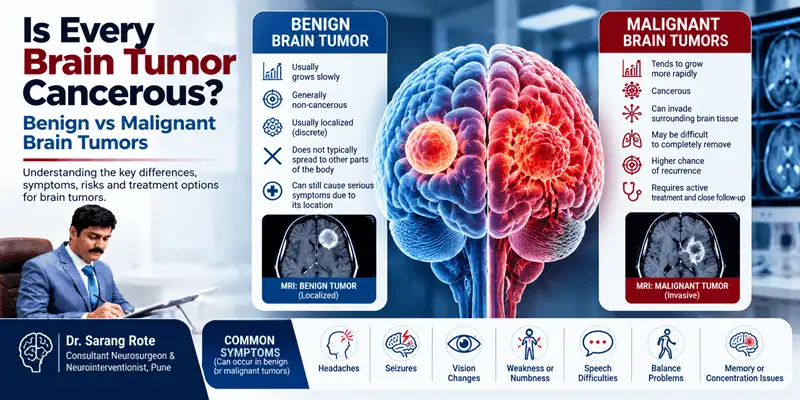
Benign vs Malignant Brain Tumors: What Is the Difference?
The main difference is how the tumor behaves and interacts with surrounding tissue.
Benign Brain Tumor
A benign tumor generally:
- Is non-cancerous
- Often grows more slowly
- Usually remains more localized
- Does not typically spread to distant organs
- Can still press on important brain structures
- May cause neurological symptoms
- May require monitoring, surgery, or other treatment depending on its location and behavior
Malignant Brain Tumor
A malignant tumor generally:
- Is cancerous
- Can grow more rapidly
- Can invade nearby brain tissue
- May be difficult to completely remove
- Can recur after treatment
- Usually requires active treatment and follow-up
The exact behavior varies considerably between different tumor types, so the terms benign and malignant alone do not tell the complete story.
Why Can a Benign Brain Tumor Still Be Serious?
This is one of the most important things patients should understand.
A benign brain tumor may not spread like cancer, but it can still cause problems simply because of where it grows.
The brain controls movement, speech, vision, memory, balance, coordination, sensation, and many other essential functions.
If a benign tumor grows near one of these areas, it can interfere with normal brain function.
For example, a tumor may cause:
- Headaches
- Seizures
- Vision changes
- Weakness or numbness
- Speech difficulties
- Balance problems
- Memory or concentration changes
- Personality or behaviour changes
- Nausea or vomiting
The symptoms depend largely on the tumor's location, size, and effect on surrounding brain structures.
Can a Benign Brain Tumor Become Dangerous?
Yes.
A benign tumor may become clinically significant if it continues to grow or begins pressing on important structures.
For example, a tumor located near the brainstem, optic pathways, cranial nerves, or areas responsible for movement and speech may cause significant problems even if the tumor itself is classified as benign.
This is why doctors do not decide treatment solely by asking whether a tumor is cancerous.
They also consider:
- Where the tumor is located
- How large it is
- How quickly it is growing
- Whether it is causing symptoms
- Whether it is pressing on important structures
- Whether it can be safely removed
- The patient's age and overall health
What Does Tumor Grade Mean?
Another important concept is tumor grade.
Tumor grade describes how abnormal the tumor cells appear under a microscope and gives doctors information about how quickly the tumor is likely to grow or behave.
For adult central nervous system tumors, grading can range from lower-grade tumors to higher-grade tumors.
Low-Grade Tumors
Lower-grade tumors generally have cells that look more similar to normal cells and tend to grow more slowly.
However, some lower-grade tumors can grow into surrounding tissue or change over time, so long-term follow-up may be necessary.
High-Grade Tumors
Higher-grade tumors tend to have more abnormal cells and may grow or spread through nearby brain tissue more rapidly.
High-grade tumors usually require more active treatment and close monitoring.
Is Tumor Grade the Same as Benign or Malignant?
Not exactly.
Benign vs malignant describes whether a tumor is considered cancerous and how it behaves.
Tumor grade provides information about the biological characteristics and expected growth behavior of the tumor.
Therefore, doctors consider several characteristics together rather than relying on one label.
The exact classification depends on the tumor type and, in many cases, microscopic and molecular examination of tumor tissue.
What Are Common Symptoms of Brain Tumors?
Brain tumor symptoms can vary considerably depending on where the tumor develops and how it affects the brain.
Common symptoms can include:
Persistent or Worsening Headaches
Headaches can occur for many reasons and most headaches are not caused by brain tumors. However, persistent or worsening headaches, particularly when accompanied by other neurological symptoms, should be medically evaluated.
Seizures
A seizure can sometimes be the first noticeable symptom of a brain tumor.
New-onset seizures require medical evaluation because they can have several possible causes.
Vision Problems
A tumor affecting areas involved in vision or nearby structures may cause blurred vision, double vision, or other visual changes.
Weakness or Numbness
Tumors affecting areas of the brain responsible for movement or sensation can cause weakness or numbness, sometimes affecting one side of the body.
Speech or Language Problems
Tumors affecting language-related areas can cause difficulty speaking, finding words, or understanding language.
Balance and Walking Problems
Tumors affecting the cerebellum or other areas involved in coordination can cause difficulty walking, balance problems, or problems with coordinated movements.
Memory or Personality Changes
Some tumors can affect memory, concentration, thinking, mood, or behaviour.
These symptoms do not automatically mean that someone has a brain tumor. Many other conditions can cause similar symptoms.
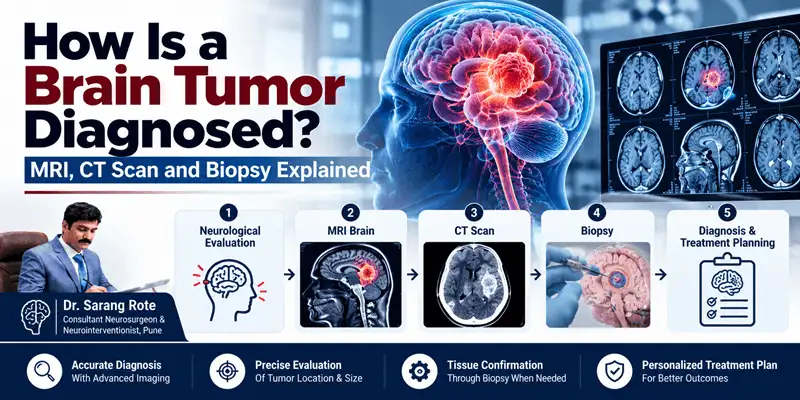
How Is a Brain Tumor Diagnosed?
If a brain tumor is suspected, doctors usually begin with a detailed medical history and neurological examination.
Brain imaging is then commonly used.
MRI Brain
MRI provides detailed images of the brain and is an important imaging test for evaluating suspected brain tumors.
It can help doctors assess the tumor's size, location, appearance, surrounding swelling, and relationship to nearby brain structures.
CT Scan
CT scans use X-rays to create cross-sectional images of the brain.
CT can be particularly useful when a rapid assessment is required and can provide important information about bleeding, calcification, skull structures, and other abnormalities.
Biopsy
Imaging can strongly suggest the presence and characteristics of a tumor, but it does not always establish the exact tumor type.
When tissue confirmation is required, a biopsy may be performed.
The tissue can then be examined under a microscope and may undergo additional laboratory and molecular testing to determine the tumor's characteristics.
Does Every Brain Tumor Need a Biopsy?
No.
A biopsy is not required in every case.
In some situations, imaging findings may strongly suggest a benign tumor and doctors may recommend observation instead of immediate biopsy.
In other situations, a biopsy or surgery may be needed to establish the diagnosis and guide treatment.
The decision depends on the tumor's location, appearance, suspected type, symptoms, and the potential risks and benefits of obtaining tissue.
Does Every Brain Tumor Need Surgery?
No.
Treatment depends on the individual tumor and patient.
Some slow-growing tumors that are small and not causing symptoms may be monitored through active surveillance, which involves regular clinical assessments and imaging.
If the tumor grows or begins causing symptoms, treatment may then be reconsidered.
Other tumors may require surgery because they are causing pressure, neurological symptoms, or other complications.
When Is Surgery Considered for a Benign Brain Tumor?
Surgery may be considered when:
- The tumor is causing significant symptoms
- The tumor is growing
- The tumor is pressing on important brain structures
- The tumor is causing increased pressure within the skull
- The tumor's location allows an acceptable surgical approach
- Tissue diagnosis is needed
- The potential benefits of surgery outweigh its risks
The decision is individualized and depends heavily on the tumor's location and relationship with important neurological structures.
When Is Surgery Considered for a Malignant Brain Tumor?
Surgery may be part of treatment for many malignant brain tumors.
The goals may include:
- Obtaining tissue for diagnosis
- Removing as much tumor as can be safely removed
- Reducing pressure on the brain
- Relieving symptoms
- Helping plan additional treatment
For some tumors, complete removal may not be possible because the tumor involves or lies close to areas responsible for important neurological functions.
In such cases, the objective may be maximal safe removal rather than removing tumor at the expense of normal brain function.
Can a Brain Tumor Spread to Other Parts of the Body?
Primary brain tumors that begin in the brain rarely spread to distant parts of the body.
However, cancer that begins elsewhere in the body can spread to the brain. These tumors are called brain metastases or metastatic brain tumors.
This distinction is important because metastatic brain tumors are treated differently from primary brain tumors.
What Determines How Serious a Brain Tumor Is?
Doctors consider several factors rather than simply asking whether a tumor is benign or malignant.
Important factors include:
Tumor Type
Different brain tumor types have different biological behaviours.
Tumor Grade
Grade provides information about how abnormal the tumor cells are and how quickly they may grow.
Tumor Location
A tumor in an area controlling speech, movement, vision, or other important functions may cause significant problems even when it is slow-growing.
Tumor Size
Larger tumors may exert more pressure on surrounding structures.
Growth Rate
A tumor that is increasing in size may require a different approach from one that remains stable.
Symptoms
The severity and progression of neurological symptoms are important considerations.
Molecular Characteristics
Modern brain tumor classification can include molecular and genetic information obtained from tumor tissue, which may influence diagnosis and treatment planning.
How Are Brain Tumors Treated?
Treatment depends on the tumor type, grade, location, size, symptoms, and overall health of the patient.
Possible approaches include:
Active Surveillance
Some slow-growing tumors that are not causing significant symptoms may be monitored through regular examinations and imaging.
Surgery
Surgery may be recommended to remove as much tumor as safely possible, obtain tissue for diagnosis, relieve pressure, or control symptoms.
Radiation Therapy
Radiation therapy may be used for certain brain tumors, either after surgery or as part of another treatment strategy.
Chemotherapy
Certain brain tumors may be treated with chemotherapy or other medicines depending on their type and molecular characteristics.
Targeted Therapy
For selected tumors with particular molecular characteristics, targeted treatments may be considered.
The appropriate treatment is determined according to the specific diagnosis rather than simply whether the tumor is called benign or malignant.
Why Is Tumor Location So Important?
The brain is responsible for many essential functions, and different areas control different abilities.
For example, tumors near areas involved in movement may cause weakness, while tumors near language-related areas may affect speech or understanding.
Tumors near the visual pathways may affect eyesight, while tumors affecting the cerebellum can interfere with coordination and balance.
Therefore, two tumors of the same size may have very different effects depending on where they are located.
Can a Benign Brain Tumor Come Back?
Some benign tumors can recur after treatment.
The likelihood depends on factors such as the specific tumor type, whether it was completely removed, its location, and other biological characteristics.
For this reason, follow-up imaging and medical assessment may be recommended even after treatment of a benign tumor.
Why Choose Dr. Sarang Rote for Brain Tumor Evaluation and Treatment?
Dr. Sarang Rote is a Consultant Neurosurgeon & Neurointerventionist in Pune. His official website lists Brain Tumor Surgery, Brain Tumors, Skull Base Neurosurgery, and Endoscopic Neuro Surgery among his services.
His website also lists areas of interest including complex brain tumors, brainstem tumors and other lesions, complex skull-base tumors, pituitary surgery, and tumor embolization. It describes his training in minimally invasive endoscopic brain and skull-base neurosurgery as well as cerebrovascular and skull-base neurosurgical training.
For a patient diagnosed with a brain tumor, specialist evaluation can help determine the significance of the tumor's type, location, size, growth characteristics, and symptoms and whether observation, surgery, or another treatment approach may be appropriate.
Frequently Asked Questions
Is every brain tumor cancer?
No. Brain tumors can be benign or malignant. A benign tumor is non-cancerous, while a malignant tumor is cancerous. However, both can cause serious problems depending on their location, size, and effect on the brain.
Is a benign brain tumor dangerous?
A benign brain tumor can still be serious. It may grow and press on important areas of the brain, nerves, or blood vessels, potentially causing neurological symptoms or other complications.
Is a malignant brain tumor always fast-growing?
Malignant tumors generally have more aggressive biological behaviour, but the exact growth pattern varies by tumor type and grade. Doctors use pathology and other tumor characteristics to understand its behaviour.
Can a benign brain tumor become cancerous?
The answer depends on the specific tumor type. Some tumors can change or progress to a higher grade, while others do not. This is why the exact diagnosis and appropriate follow-up are important.
Does a benign brain tumor always need surgery?
No. Some benign, slow-growing tumors that are not causing symptoms may be monitored with regular imaging. Surgery may be considered if the tumor grows, causes symptoms, or affects important brain structures.
Can a brain tumor be removed completely?
Sometimes, but not always. The possibility of complete removal depends heavily on the tumor's type, location, size, and relationship with important brain structures. In some cases, maximal safe removal is preferred to avoid damaging normal brain tissue.
Final Takeaway
Not every brain tumor is cancerous.
Brain tumors can be benign or malignant, but the word “benign” does not necessarily mean harmless, especially when a tumor is located near an important area of the brain.
The seriousness of a brain tumor depends on much more than whether it is cancerous. Doctors consider the tumor type, grade, size, location, growth pattern, symptoms, molecular characteristics, and whether it can be safely treated.
If you or a family member has been diagnosed with a brain tumor, a detailed evaluation by a neurosurgeon can help explain what the diagnosis means and what treatment or monitoring options may be appropriate.
If you have a brain tumor diagnosis or an abnormal finding on MRI or CT, consult a qualified neurosurgeon for an individualized evaluation.



















.jpeg)