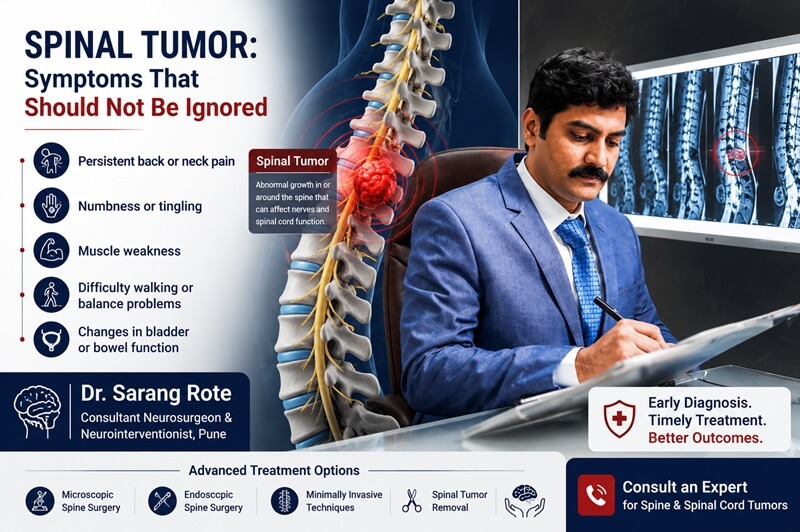
Spinal Tumor: Symptoms That Should Not Be Ignored
Back pain is extremely common and is often caused by conditions such as muscle strain, disc problems or arthritis. However, persistent or progressively worsening back or neck pain, especially when accompanied by neurological symptoms, should not always be dismissed.
A spinal tumor is an abnormal growth that develops in or around the spine, spinal cord or the nerves surrounding it. Some spinal tumors are benign and slow-growing, while others can be malignant or may represent cancer that has spread from another part of the body.
Because a spinal tumor can press on the spinal cord or nerves, early recognition of concerning symptoms and appropriate evaluation can help protect nerve function, mobility and quality of life.
What Is a Spinal Tumor?
A spinal tumor is an abnormal growth that occurs in or around the spine.
Spinal tumors can develop in different locations, including:
- The bones of the spine
- The spinal cord
- The coverings around the spinal cord
- The nerve roots
- Tissues surrounding the spine
Some spinal tumors begin in the spine itself. These are called primary spinal tumors.
Other tumors develop elsewhere in the body and later spread to the spine. These are called metastatic or secondary spinal tumors.
A spinal tumor may be benign or malignant. However, even a benign tumor can cause serious problems if it presses on the spinal cord or important nerves.
Types of Spinal Tumors
Spinal tumors can be broadly classified according to where they develop.
Vertebral Tumors
These tumors develop in the bones of the spine.
They may be benign or malignant. Some tumors can weaken the vertebrae and increase the risk of spinal instability or fracture.
Intradural Extramedullary Tumors
These tumors develop inside the protective covering of the spinal cord but outside the spinal cord itself.
Examples include:
- Meningioma
- Schwannoma
- Neurofibroma
These tumors may cause symptoms by pressing against the spinal cord or nerve roots.
Intramedullary Tumors
These tumors develop within the spinal cord itself.
Examples include:
- Ependymoma
- Astrocytoma
- Other spinal cord gliomas
Because they develop within the spinal cord, their treatment can require highly careful planning to protect normal neurological function.
Symptoms of a Spinal Tumor
The symptoms of a spinal tumor depend on its location, size, growth rate and whether it is pressing on the spinal cord or nerves.
Some tumors may initially cause very few symptoms.
Common warning signs include:
- Persistent back pain
- Persistent neck pain
- Pain that becomes worse over time
- Pain that is worse at night or while lying down
- Pain that radiates into the arms or legs
- Numbness or tingling
- Muscle weakness
- Difficulty walking
- Balance or coordination problems
- Changes in sensation
- Muscle spasms
- Changes in bladder or bowel control
These symptoms can also occur with many other spinal conditions. Their presence does not automatically mean that a person has a tumor.
However, persistent, progressive or unexplained symptoms should be evaluated by an appropriate healthcare professional.
1. Persistent Back or Neck Pain
Persistent pain is one of the symptoms that should not be ignored when it has no clear explanation or continues to worsen.
Pain associated with a spinal tumor may be:
- Constant or progressive
- Located near the tumor
- Sharp, dull or burning
- Radiating into an arm, leg, chest or hip
- Worse at night
- Worse while lying down
- Not adequately relieved by usual measures
Most back pain is not caused by a spinal tumor. However, persistent or worsening pain deserves appropriate evaluation.
2. Pain That Gets Worse at Night
Back or neck pain that repeatedly becomes worse at night or while lying down can be a reason to seek medical evaluation.
Night pain is not specific to spinal tumors and can occur with many other conditions.
However, when night pain is persistent or occurs together with neurological symptoms, further evaluation may be appropriate.
3. Numbness or Tingling
A spinal tumor can compress or affect spinal nerves, resulting in changes in sensation.
Patients may experience:
- Numbness
- Tingling
- Pins-and-needles sensation
- Reduced sensitivity to touch
- Reduced sensitivity to temperature or pain
- Burning sensations
The location of numbness may provide clues about which nerves or areas of the spinal cord are affected.
4. Muscle Weakness
Weakness in the arms or legs can occur when a tumor affects the spinal cord or nerve roots.
Patients may notice:
- Difficulty lifting an arm or leg
- Difficulty climbing stairs
- Trouble standing for long periods
- Difficulty gripping objects
- Frequent tripping
- A feeling that the legs are becoming heavy
Progressive weakness should be evaluated promptly because prolonged pressure on the spinal cord or nerves can potentially result in lasting neurological problems.
5. Difficulty Walking or Balance Problems
A spinal tumor can interfere with the nerve pathways responsible for movement and coordination.
Patients may notice:
- Unsteady walking
- Frequent falls
- Difficulty maintaining balance
- Changes in walking pattern
- Difficulty coordinating movements
- Increasing dependence on support while walking
New or progressively worsening walking difficulties require medical evaluation.
6. Changes in Bladder or Bowel Function
Changes in bladder or bowel control can be an important neurological warning sign when associated with spinal problems.
These may include:
- Difficulty passing urine
- Loss of bladder control
- New urinary urgency
- Loss of bowel control
- Difficulty controlling bowel movements
Sudden or rapidly developing bladder or bowel dysfunction, especially when associated with leg weakness or numbness, requires urgent medical assessment.
7. Changes in Sensation
A spinal tumor can affect the pathways that carry sensory information between the body and brain.
This may cause changes in:
- Touch sensation
- Temperature sensation
- Pain sensation
- Position awareness
The symptoms may appear gradually and may affect specific areas of the body depending on the location of the tumor.
Spinal Tumor Symptoms That Need Urgent Attention
Some symptoms should not be delayed or ignored.
Seek urgent medical attention if a person develops:
- Rapidly worsening weakness
- New difficulty walking
- Sudden loss of bladder or bowel control
- Severe numbness
- Numbness around the genital or inner-thigh region
- Severe back pain associated with neurological changes
- Sudden or rapidly worsening neurological symptoms
These symptoms can have several possible causes, including serious spinal cord or nerve compression, and require prompt medical assessment.
What Causes Spinal Tumors?
For many spinal tumors, the exact cause is not known.
Some primary spinal tumors may be associated with genetic changes or rare inherited conditions.
In adults, tumors involving the spine can also occur because cancer from another part of the body has spread to the spine.
Cancers that can spread to the spine include cancers originating in organs such as:
- Breast
- Lung
- Prostate
- Kidney
- Thyroid
- Gastrointestinal tract
Other cancers and blood-related cancers can also involve the spine.
A history of cancer combined with new or unexplained back pain should be discussed with a healthcare professional.
How Is a Spinal Tumor Diagnosed?
Diagnosis usually begins with a detailed medical history and physical examination.
The doctor may assess:
- Muscle strength
- Reflexes
- Sensation
- Balance
- Coordination
- Walking
- Bladder and bowel symptoms
- Location and characteristics of pain
Based on the findings, imaging and other investigations may be recommended.
MRI Scan for Spinal Tumor
MRI is one of the most important imaging tests for evaluating spinal tumors.
MRI can provide detailed images of:
- The spinal cord
- Nerves
- Soft tissues
- Vertebrae
- Tumor location
- Spinal cord compression
Contrast-enhanced MRI may be recommended in selected situations to provide additional information about the tumor.
MRI can help doctors understand the relationship between the tumor and surrounding spinal structures and plan further treatment.
CT Scan
CT scans can provide detailed information about the bones of the spine.
They may help identify:
- Bone destruction
- Spinal instability
- Fractures
- Calcification
- Changes in vertebral structure
CT may also be used when MRI is not suitable or when additional information about the bones is required.
X-Ray
X-rays may show certain changes in the bones of the spine, including structural abnormalities or fractures.
However, X-rays do not provide the same level of detail for soft-tissue tumors or spinal cord lesions as MRI.
Therefore, additional imaging may be required when a spinal tumor is suspected.
Biopsy
In selected cases, a biopsy may be required to determine the exact type of tumor.
A small tissue sample is collected and examined in a laboratory.
The biopsy results can help determine:
- Tumor type
- Whether it is benign or malignant
- Tumor characteristics
- Appropriate treatment strategy
Biopsy planning is important because the procedure needs to be performed in a way that does not interfere with potential future surgery.
Spinal Tumor Treatment Options
Treatment depends on several factors, including:
- Tumor type
- Tumor size
- Tumor location
- Whether the tumor is benign or malignant
- Whether the tumor has spread
- Pressure on the spinal cord
- Neurological symptoms
- Patient's age and overall health
Treatment options may include:
- Observation
- Surgery
- Radiation therapy
- Medicines
- Chemotherapy
- Targeted therapy
- Other specialised treatments
Not every spinal tumor requires immediate treatment.
Observation and Regular Monitoring
Small, slow-growing tumors that are not causing significant symptoms may sometimes be monitored with regular imaging.
Follow-up may include:
- Neurological examinations
- MRI scans
- Assessment of symptoms
- Monitoring of tumor growth
If the tumor begins to grow or causes neurological symptoms, treatment may then be recommended.
Spinal Tumor Surgery
Surgery may be considered when a tumor is causing pressure on the spinal cord or nerves, producing neurological symptoms, causing spinal instability or when complete or significant tumor removal is considered appropriate.
The goals of surgery may include:
- Removing the tumor
- Relieving pressure on the spinal cord
- Protecting nerve function
- Stabilising the spine when necessary
- Reducing pain
- Obtaining tissue for diagnosis
The surgical approach depends on the location and type of tumor.
Microsurgical Treatment
Microsurgical techniques allow the surgeon to work with detailed visualisation of the spinal cord, nerves and tumor.
Careful surgical planning is particularly important for tumors located close to important neurological structures.
The objective is to remove the tumor as safely as possible while protecting normal spinal cord and nerve function.
Minimally Invasive and Endoscopic Spine Surgery
In selected spinal conditions, minimally invasive or endoscopic techniques may be considered.
These approaches use specialised instruments and smaller access pathways when clinically appropriate.
The suitability of a minimally invasive technique depends on:
- Tumor location
- Tumor size
- Tumor type
- Relationship with the spinal cord
- Involvement of surrounding structures
Not every spinal tumor is suitable for an endoscopic or minimally invasive approach.
Radiation Therapy
Radiation therapy may be used for selected spinal tumors, particularly certain malignant tumors or tumors that cannot be completely removed surgically.
Radiation may also be used after surgery or as part of treatment for metastatic spinal tumors.
The treatment plan depends on the tumor type and overall clinical situation.
Medicines and Other Treatments
Depending on the type of spinal tumor, additional treatments may include:
- Chemotherapy
- Targeted therapy
- Immunotherapy
- Steroids to reduce swelling around the spinal cord
- Other cancer-specific medicines
These treatments are selected according to the tumor's pathology and the patient's overall medical condition.
Spinal Tumor Treatment in Pune
Spinal tumor treatment requires careful assessment of the tumor, spinal cord, nerves and surrounding structures.
Dr. Sarang Rote is a Consultant Neurosurgeon & Neurointerventionist in Pune. His website states that he has experience in brain and spine tumors as well as microscopic and endoscopic spine surgery.
His neurosurgical practice also focuses on advanced minimally invasive modalities and technology where clinically appropriate.
For patients with suspected or diagnosed spinal tumors, specialist evaluation can help determine the appropriate diagnostic and treatment pathway.
Why Choose Dr. Sarang Rote?
Spinal tumors can be complex because treatment must address the tumor while protecting the spinal cord and surrounding nerves.
Dr. Sarang Rote's website highlights his experience in:
- Brain and spine tumors
- Microscopic spine surgery
- Endoscopic spine surgery
- Neurosurgery
- Advanced minimally invasive surgical modalities
- Complex neurosurgical conditions
His website also identifies him as a Consultant Neurosurgeon & Neurointerventionist in Pune.
A specialist evaluation can help determine whether observation, surgery, radiation or another treatment strategy is appropriate for an individual patient.
Can a Spinal Tumor Be Prevented?
Most spinal tumors cannot be completely prevented because many develop without a clearly identifiable cause.
However, maintaining overall health, avoiding tobacco use and following recommended medical care can support general health.
People with a previous history of cancer should also discuss new or persistent back pain with their healthcare team because some cancers can spread to the spine.
Recovery After Spinal Tumor Treatment
Recovery depends on:
- Tumor type
- Tumor location
- Size of the tumor
- Degree of spinal cord or nerve compression
- Type of treatment
- Neurological condition before treatment
- Overall health
Some patients may require rehabilitation after treatment.
Rehabilitation may include:
- Physiotherapy
- Strength and mobility exercises
- Walking rehabilitation
- Occupational therapy
- Pain management
- Neurological follow-up
Early treatment of spinal cord compression may help protect neurological function and mobility.
Frequently Asked Questions About Spinal Tumors
1. What is a spinal tumor?
A spinal tumor is an abnormal growth that develops in or around the spine, spinal cord, nerves or surrounding tissues. It may be benign or malignant.
2. What are the most common symptoms of a spinal tumor?
Common symptoms include persistent back or neck pain, pain that worsens at night, numbness, tingling, muscle weakness, difficulty walking and balance problems.
3. Is back pain always a sign of a spinal tumor?
No. Most back pain is caused by common conditions such as muscle strain, arthritis or disc problems. However, persistent, progressive or unexplained pain, especially with neurological symptoms, should be evaluated.
4. Why is spinal tumor pain sometimes worse at night?
Spinal tumor pain may become more noticeable at night or while lying down. Night pain can have many causes, so it does not by itself confirm the presence of a tumor.
5. Can a spinal tumor cause leg weakness?
Yes. A tumor can compress the spinal cord or nerve roots and cause weakness in the legs or arms depending on its location.
6. Can a spinal tumor cause numbness?
Yes. Compression or irritation of the spinal cord or nerves can cause numbness, tingling or changes in sensation.
7. Can a spinal tumor affect bladder or bowel control?
Yes. Significant compression of certain parts of the spinal cord or nerves can affect bladder and bowel function. New loss of bladder or bowel control requires urgent medical assessment.
8. Is MRI necessary for diagnosing a spinal tumor?
MRI is an important imaging test for spinal tumors because it provides detailed images of the spinal cord, nerves and soft tissues. The doctor may recommend additional tests depending on the situation.
9. Does every spinal tumor require surgery?
No. Some small or slow-growing tumors may be monitored. Others may require surgery, radiation, medicines or a combination of treatments.
10. Can a spinal tumor be treated with minimally invasive surgery?
Selected spinal tumors or spinal conditions may be suitable for minimally invasive or endoscopic approaches. The appropriate technique depends on the tumor's size, location and relationship with the spinal cord and nerves.
11. Can spinal tumors be cancerous?
Yes. Some spinal tumors are malignant. In adults, many malignant tumors involving the spine are metastatic cancers that have spread from another part of the body.
12. Who should I consult for a spinal tumor in Pune?
A patient with a suspected or diagnosed spinal tumor should be evaluated by an experienced neurosurgeon or appropriate multidisciplinary team. Dr. Sarang Rote is a Consultant Neurosurgeon & Neurointerventionist in Pune with experience in brain and spine tumors and microscopic and endoscopic spine surgery.
Conclusion
A spinal tumor is uncommon, but its symptoms can sometimes resemble ordinary back or neck problems.
Persistent or worsening pain, pain that becomes worse at night, unexplained numbness, weakness, difficulty walking, balance problems or changes in bladder and bowel function should not be ignored.
Early evaluation can help identify the cause of these symptoms and, when a spinal tumor is present, allow appropriate treatment planning before neurological damage becomes more severe.
Depending on the tumor type and location, treatment may include observation, microsurgery, minimally invasive or endoscopic surgery, radiation therapy, medicines or a combination of treatments.
If you have persistent or progressive spinal symptoms, consult an appropriate specialist for a detailed neurological and spinal evaluation.
#SpinalTumor #SpinalTumorSymptoms #SpinalTumorTreatment #SpineTumor #SpinalCordTumor #SpinalCordCompression #SpineSurgery #MicroscopicSpineSurgery #EndoscopicSpineSurgery #NeurosurgeonInPune #SpineCare #Neurosurgery #DrSarangRote
















.jpeg)