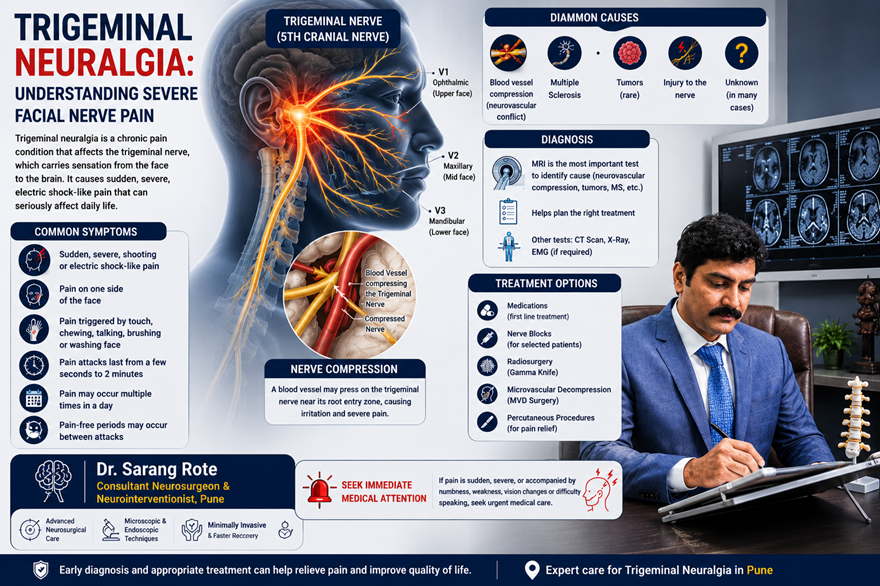
Trigeminal Neuralgia: Understanding Severe Facial Nerve Pain
A sudden, intense facial pain that feels like an electric shock can be extremely distressing. When this type of pain repeatedly affects one side of the face, it may be related to a condition called trigeminal neuralgia.
Trigeminal neuralgia is a chronic nerve pain condition involving the trigeminal nerve, which carries sensation from the face to the brain. Even simple activities such as eating, talking, brushing the teeth or touching the face can sometimes trigger severe episodes of pain.
Although trigeminal neuralgia can significantly affect daily life, appropriate diagnosis and treatment can help many patients control their symptoms.
What Is Trigeminal Neuralgia?
Trigeminal neuralgia is a neurological condition that causes sudden, severe pain involving one or more areas supplied by the trigeminal nerve.
The trigeminal nerve is the fifth cranial nerve and has three major branches. It carries sensation from areas including:
- Forehead
- Eye region
- Cheeks
- Nose
- Upper and lower jaw
- Teeth
- Gums
- Lips
When the trigeminal nerve becomes irritated or compressed, abnormal pain signals can be sent to the brain.
The pain is often described as:
- Electric shock-like
- Shooting
- Stabbing
- Burning
- Sudden and severe
Episodes can last from a fraction of a second to several minutes and may occur repeatedly throughout the day.
Why Is Trigeminal Neuralgia Called Severe Facial Nerve Pain?
Unlike ordinary facial discomfort, trigeminal neuralgia can produce extremely intense bursts of pain.
The pain may occur suddenly and without warning or may be triggered by very light stimulation of the face.
A patient may experience severe pain simply while:
- Brushing the teeth
- Washing the face
- Eating
- Drinking
- Speaking
- Smiling
- Shaving
- Applying makeup
- Feeling a breeze on the face
These seemingly normal activities can become difficult when pain attacks are frequent.
Symptoms of Trigeminal Neuralgia
The symptoms can vary from person to person, but typical features include:
- Sudden severe facial pain
- Electric shock-like pain
- Shooting or stabbing pain
- Pain usually affecting one side of the face
- Pain involving the cheek or jaw
- Pain around the teeth or gums
- Pain triggered by touching the face
- Pain triggered by chewing or talking
- Facial muscle spasms in some patients
- Increasing frequency of pain attacks over time
Some patients experience periods without pain, followed by recurrent episodes.
1. Sudden Electric Shock-Like Facial Pain
One of the most characteristic symptoms is sudden, intense pain that may feel like an electrical shock.
The attack may begin abruptly and disappear just as quickly.
Patients often describe it as:
- A sharp jolt
- An electric shock
- A stabbing sensation
- A sudden burning pain
- A severe shooting sensation
This distinctive pain pattern can help doctors differentiate trigeminal neuralgia from other causes of facial pain.
2. Pain on One Side of the Face
Trigeminal neuralgia most commonly affects one side of the face at a time.
The pain may involve:
- One cheek
- One side of the jaw
- Upper or lower teeth
- Lips
- Around the eye
- Forehead
The exact location depends on which branch of the trigeminal nerve is involved.
3. Pain Triggered by Touch
Even gentle contact with the face can trigger an attack.
Possible triggers include:
- Touching the face
- Washing the face
- Shaving
- Applying makeup
- Brushing the teeth
- Eating
- Drinking
- Talking
- Smiling
- A light breeze
The sensitivity to ordinary facial activities is one of the important clues that can suggest trigeminal neuralgia.
4. Pain While Eating or Chewing
Chewing can trigger severe pain because movement of the jaw may stimulate the affected trigeminal nerve.
Some patients may begin avoiding food or eating less because they are afraid of triggering another attack.
If facial pain repeatedly occurs while chewing, especially when dental examination does not identify a clear cause, neurological evaluation may be appropriate.
5. Pain While Brushing the Teeth
Brushing the teeth can sometimes trigger an attack.
This can make normal dental hygiene difficult.
Because trigeminal neuralgia pain can occur around the teeth and gums, some patients initially visit a dentist believing that the pain is caused by a dental problem.
6. Pain While Talking
Speaking and facial movements can trigger pain attacks in some patients.
Repeated attacks may make patients reluctant to speak or participate in normal social activities.
This can significantly affect communication and quality of life.
What Causes Trigeminal Neuralgia?
The causes of trigeminal neuralgia can vary.
In classic trigeminal neuralgia, a blood vessel near the base of the brain presses against the trigeminal nerve.
Other possible causes include:
- Multiple sclerosis
- Tumors affecting the trigeminal nerve
- Facial trauma
- Previous surgery affecting the nerve
- Stroke-related nerve damage
- Other neurological conditions
In some patients, no definite cause can be identified.
Blood Vessel Compression of the Trigeminal Nerve
In classic trigeminal neuralgia, a blood vessel may come into contact with and compress the trigeminal nerve near its origin.
This pressure can interfere with normal nerve function and cause abnormal pain signals.
Identifying this type of nerve compression can be important when considering surgical treatment such as microvascular decompression.
Trigeminal Neuralgia and Multiple Sclerosis
Multiple sclerosis can damage the protective covering of nerves and may sometimes cause trigeminal neuralgia.
When trigeminal neuralgia occurs in a younger patient or when other neurological symptoms are present, doctors may consider underlying neurological conditions as part of the evaluation.
MRI can help identify certain underlying causes.
Can a Tumor Cause Trigeminal Neuralgia?
In some cases, a tumor or other structural lesion can affect the trigeminal nerve and cause facial pain.
This is one reason imaging may be recommended, particularly when symptoms are atypical or when the doctor wants to identify the underlying cause.
An MRI can help evaluate the trigeminal nerve and surrounding brain structures.
Who Is More Likely to Develop Trigeminal Neuralgia?
Trigeminal neuralgia is more common in older adults and occurs more frequently in women.
It is particularly seen in people over the age of 50, although younger people can also develop the condition.
Certain conditions, including multiple sclerosis and hypertension, have also been associated with an increased risk.
Trigeminal Neuralgia vs Dental Pain
Because trigeminal neuralgia can cause pain around the teeth, jaw and gums, it can sometimes be mistaken for a dental problem.
Dental causes of facial pain may include:
- Dental infection
- Tooth decay
- Cracked tooth
- Gum disease
- Dental abscess
If dental examination does not identify a clear explanation for repeated electric shock-like facial pain, a neurological evaluation may be appropriate.
When Should You See a Doctor?
You should seek medical evaluation if you experience:
- Repeated severe facial pain
- Electric shock-like pain
- Facial pain without an obvious dental cause
- Pain triggered by eating or talking
- Pain triggered by light facial touch
- Increasing frequency of attacks
- Pain that interferes with eating or drinking
- Pain that affects sleep or daily activities
- Facial pain that does not improve with usual pain medicines
Accurate diagnosis is important because many conditions can cause facial pain.
When Should You Consult a Neurosurgeon?
A neurosurgical consultation may be considered when:
- The diagnosis of trigeminal neuralgia is suspected or confirmed
- Medicines do not provide adequate relief
- Pain keeps returning despite treatment
- Medication side effects become difficult to tolerate
- MRI shows blood vessel compression of the trigeminal nerve
- A structural lesion is suspected
- Surgical treatment is being considered
- Pain is significantly affecting quality of life
A neurosurgeon can evaluate whether a surgical or minimally invasive treatment may be appropriate.
How Is Trigeminal Neuralgia Diagnosed?
There is no single test that confirms every case of trigeminal neuralgia.
Diagnosis is primarily based on:
- The pattern of pain
- Location of pain
- Duration of attacks
- Frequency of attacks
- Triggering factors
- Neurological examination
- Imaging when required
Doctors also need to rule out other causes of facial pain, including dental conditions and other neurological disorders.
Neurological Examination
During an examination, the doctor may assess:
- Sensation on different parts of the face
- Facial movements
- Reflexes
- Jaw movement
- Other neurological functions
The examination can help determine whether the trigeminal nerve or another neurological structure may be involved.
MRI for Trigeminal Neuralgia
MRI is an important imaging test when evaluating trigeminal neuralgia.
It may help identify:
- Blood vessel contact or compression
- Multiple sclerosis-related changes
- Tumors
- Other structural abnormalities
- Changes affecting the trigeminal nerve
Specialised MRI techniques may provide detailed images of the trigeminal nerve and surrounding structures.
Why Is Finding the Cause Important?
Trigeminal neuralgia can have different causes, and treatment depends partly on the underlying cause.
For example:
- Blood vessel compression may make microvascular decompression an option.
- Multiple sclerosis may require treatment of the underlying neurological condition.
- A tumor may require specific tumor treatment.
- When no structural cause is identified, medical treatment may be the primary approach.
Therefore, proper diagnosis is an important part of treatment planning.
Treatment Options for Trigeminal Neuralgia
Treatment may include:
- Medicines
- Nerve-related pain treatments
- Injections in selected situations
- Microvascular decompression
- Stereotactic radiosurgery
- Rhizotomy procedures
- Other specialised interventions
The appropriate treatment depends on the patient's symptoms, cause, medical history, response to previous treatment and overall health.
Medicines for Trigeminal Neuralgia
Medicines are commonly used as the initial treatment for trigeminal neuralgia.
Antiseizure medicines such as carbamazepine or oxcarbazepine are commonly used to reduce abnormal pain signalling.
Other medicines may be considered when the first treatment is ineffective or unsuitable.
Medication should be prescribed and monitored by a qualified healthcare professional because these medicines can cause side effects and may require gradual dose adjustment.
Why Ordinary Painkillers May Not Work
Trigeminal neuralgia is nerve-related pain rather than ordinary muscle or tissue pain.
As a result, commonly used over-the-counter pain medicines may not provide adequate relief for typical trigeminal neuralgia attacks.
Specific nerve-pain medications are generally used instead.
Microvascular Decompression
Microvascular decompression, or MVD, is a surgical treatment that may be considered when a blood vessel is compressing the trigeminal nerve.
During the procedure, the surgeon moves the blood vessel away from the nerve and places a protective material between them.
The goal is to relieve the abnormal pressure without intentionally damaging the trigeminal nerve.
MVD can provide long-term pain relief for appropriately selected patients, but it is a major neurosurgical procedure and carries potential risks.
Stereotactic Radiosurgery
Stereotactic radiosurgery is a non-invasive treatment option for selected patients.
A focused dose of radiation is directed toward the trigeminal nerve to reduce its ability to transmit pain signals.
Pain relief may take time to develop after treatment.
Facial numbness or tingling can occur as a side effect.
Rhizotomy Procedures
Rhizotomy procedures aim to reduce pain by selectively damaging part of the trigeminal nerve responsible for transmitting pain signals.
Different techniques include:
- Glycerol injection
- Balloon compression
- Radiofrequency thermal lesioning
These procedures may be considered in selected patients when medication is not effective or other treatments are unsuitable.
Facial numbness can occur after these procedures.
Balloon Compression
Balloon compression is a minimally invasive procedure in which a small balloon is positioned near the trigeminal nerve and inflated for a controlled period.
The purpose is to interrupt pain signals from the affected nerve.
It can provide pain relief in selected patients, although temporary or persistent facial numbness may occur.
Radiofrequency Treatment
Radiofrequency thermal lesioning is another minimally invasive treatment option.
A specialised electrode is positioned near the trigeminal nerve, and controlled heat is used to affect selected pain-transmitting nerve fibres.
The procedure can provide pain relief, but facial numbness may occur and pain can return in some patients.
Can Trigeminal Neuralgia Be Cured?
There is no single treatment that guarantees permanent relief for every patient.
However, many patients can achieve significant pain control with medication or procedures.
For patients with classic trigeminal neuralgia caused by vascular compression, microvascular decompression may provide long-lasting relief in appropriately selected cases.
Living With Trigeminal Neuralgia
Repeated facial pain can affect:
- Eating
- Drinking
- Speaking
- Brushing teeth
- Social interaction
- Work
- Sleep
- Emotional wellbeing
Keeping a record of pain attacks and identifying triggers can help the doctor understand the condition and evaluate treatment response.
Patients should also follow their prescribed treatment plan and discuss medication side effects rather than stopping medicines suddenly.
Trigeminal Neuralgia Treatment in Pune
Trigeminal neuralgia is a neurological condition that may require detailed evaluation of the trigeminal nerve and surrounding structures.
Dr. Sarang Rote is a Consultant Neurosurgeon & Neurointerventionist in Pune. His official website highlights his expertise in neurosurgery, skull-base neurosurgery, microscopic and endoscopic procedures, and advanced minimally invasive neurosurgical techniques.
For patients with persistent or severe facial nerve pain, specialist evaluation can help determine whether the symptoms are related to trigeminal neuralgia and whether medical, minimally invasive or surgical treatment may be appropriate.
Why Choose Dr. Sarang Rote?
Trigeminal neuralgia requires careful differentiation from dental, sinus, headache and other neurological causes of facial pain.
Dr. Sarang Rote is a Consultant Neurosurgeon & Neurointerventionist in Pune with focused neurosurgical training and experience in advanced neurosurgical procedures. His official profile highlights microscopic and endoscopic neurosurgery and advanced minimally invasive modalities.
Patients may consider specialist evaluation for:
- Detailed neurological assessment
- Evaluation of severe facial nerve pain
- Assessment of possible structural nerve compression
- MRI-based treatment planning
- Evaluation of medical treatment response
- Discussion of appropriate surgical or minimally invasive options
The appropriate treatment should always be selected according to the individual patient's diagnosis and clinical condition.
Can Trigeminal Neuralgia Be Prevented?
There is no guaranteed way to prevent classic trigeminal neuralgia because the exact cause is not always known.
However, identifying and treating underlying conditions that may contribute to secondary trigeminal neuralgia can be important.
Patients with persistent facial pain should seek appropriate medical evaluation rather than repeatedly treating the symptoms as dental or ordinary facial pain.
Frequently Asked Questions About Trigeminal Neuralgia
1. What is trigeminal neuralgia?
Trigeminal neuralgia is a neurological condition that causes sudden, severe, electric shock-like pain involving areas of the face supplied by the trigeminal nerve.
2. What does trigeminal neuralgia pain feel like?
The pain is often described as an electric shock, stabbing, shooting or sudden burning sensation. Attacks can be extremely intense and may last from a fraction of a second to several minutes.
3. What triggers trigeminal neuralgia?
Common triggers include touching the face, eating, drinking, talking, brushing the teeth, shaving, washing the face, smiling and even a light breeze.
4. Is trigeminal neuralgia usually on one side?
Yes. Trigeminal neuralgia typically affects one side of the face at a time.
5. Can trigeminal neuralgia feel like tooth pain?
Yes. Because the trigeminal nerve supplies sensation to the teeth and jaw, the pain can feel like severe dental pain. This is why some patients initially visit a dentist.
6. What causes trigeminal neuralgia?
A common cause is a blood vessel pressing on the trigeminal nerve. Other causes can include multiple sclerosis, tumors, facial trauma or nerve injury. In some cases, no definite cause is identified.
7. Is MRI required for trigeminal neuralgia?
MRI may be recommended to look for possible causes such as blood vessel compression, multiple sclerosis or a tumor affecting the trigeminal nerve.
8. Can trigeminal neuralgia be treated without surgery?
Yes. Medicines are commonly used as the first-line treatment. Some patients achieve good pain control without surgery.
9. When is surgery considered for trigeminal neuralgia?
Surgery may be considered when medication does not adequately control the pain, causes unacceptable side effects, or when imaging shows a suitable structural cause such as vascular compression.
10. What is microvascular decompression?
Microvascular decompression is a neurosurgical procedure that moves a blood vessel away from the trigeminal nerve to relieve pressure on the nerve. It can provide long-term pain relief in appropriately selected patients.
11. Is Gamma Knife used for trigeminal neuralgia?
Yes. Stereotactic radiosurgery, commonly referred to as Gamma Knife treatment, can be used in selected patients to target the trigeminal nerve with focused radiation.
12. Can trigeminal neuralgia come back after treatment?
Yes. Pain can return after some treatments, including surgical and radiosurgical procedures. The possibility depends on the treatment and individual patient factors.
13. Can trigeminal neuralgia affect eating and speaking?
Yes. Eating, chewing and speaking can trigger pain attacks, and severe symptoms may significantly interfere with normal daily activities.
14. When should I consult a neurosurgeon for facial nerve pain?
A neurosurgical consultation may be appropriate when severe facial pain is recurrent, typical treatments are not working, medication side effects are difficult to tolerate, or a structural cause such as trigeminal nerve compression is suspected.
15. Who should I consult for trigeminal neuralgia in Pune?
Patients with suspected trigeminal neuralgia can seek evaluation from a neurologist or neurosurgeon. Dr. Sarang Rote is a Consultant Neurosurgeon & Neurointerventionist in Pune with expertise in advanced neurosurgical procedures.
Conclusion
Trigeminal neuralgia is a condition that can cause some of the most severe forms of facial nerve pain.
Sudden electric shock-like pain, especially when triggered by eating, talking, brushing the teeth or lightly touching the face, should not be dismissed as ordinary dental or facial pain.
Accurate diagnosis is important because trigeminal neuralgia can have different causes, including blood vessel compression, multiple sclerosis, tumors and other neurological conditions.
MRI and neurological evaluation can help identify possible causes and guide treatment planning.
Many patients can achieve pain control with appropriate medicines. When medication is ineffective or unsuitable, procedures such as microvascular decompression, stereotactic radiosurgery or selected rhizotomy techniques may be considered.
If recurrent facial pain is interfering with eating, speaking, sleeping or daily life, seek appropriate specialist evaluation to identify the cause and discuss suitable treatment options.
#TrigeminalNeuralgia #TrigeminalNeuralgiaTreatment #FacialNervePain #FacialPain #TrigeminalNerve #TrigeminalNeuralgiaPune #FacialPainTreatment #MicrovascularDecompression #MVD #GammaKnife #Neurosurgery #NeurosurgeonInPune #BrainAndSpineSpecialist #DrSarangRote



.jpeg)